
Seamless Rain Gutters in Ohio (OH)
Anywhere in Ohio, the forming machine comes to the house. One continuous gutter per run, downspouts sized to match, one written figure for all of it.
The call costs nothing and commits you to nothing. Any trip fee for the measure is named when the date is set, and the written figure follows the measure.
- Counties covered
- 88
- Region
- Midwest
- Largest city
- Columbus
Finding the best seamless rain gutters in Ohio
Getting high-quality water drainage systems protects your foundation from heavy Midwest storms while preventing wood rot around your roofline. These continuous metal channels provide the ultimate defense against leaks because they lack the joints that usually cause drips. You can easily request a free quote to find a local installer who will measure your home and provide a custom fit that lasts.
Why seamless systems change the game
Traditional options often have seams every ten feet which eventually pull apart after many freeze and thaw cycles. Choosing a continuous design eliminates those weak points entirely and keeps your siding dry throughout the rainy season. This structural integrity means you save money on repairs over time since the metal stays straight and aligned.
Actually, the material used for these custom troughs is usually heavy-gauge aluminum or copper that resists rust for decades. Because they are formed on-site to match the exact length of your eaves, they look much better than store-bought sections. That sleek appearance adds a sense of aesthetic relief to your exterior by blending right into the trim.
Understanding the benefits of professional installation
Properly pitched channels ensure that rainwater moves away from your walls instead of pooling near your home. Professionals use specialized machinery to roll-form the metal right in your driveway, which ensures a perfect fit for any roof angle. This precision reduces the risk of water overflowing onto your walkways during a downpour.
Moreover, a local installer knows the specific weather patterns across the state and understands the weight of heavy ice buildup. They will attach your new system with hidden hangers that are stronger than the old spikes and ferrules. This solid mounting technique keeps the water management hardware securely attached even during the strongest winter winds.
Comparing materials for your local home
Choosing the right metal depends on your budget and the style of your house exterior. Aluminum is the most popular choice in this region because it is lightweight, affordable, and comes in many colors. This versatility allows you to match your trim or siding for a clean look that stays consistent.
Conversely, copper offers an unmatched lifespan and develops a beautiful patina that looks more natural with age. While the cost is higher, the long-term value makes it a smart choice for historic homes in the area. That longevity provides you with a sense of lasting ease because you will not need to replace it anytime soon.
How to prepare for a smooth upgrade
Before you start, check your existing drainage to see if there are signs of sagging or detached sections. If you notice water spilling over the edges, it is time to upgrade to a system that handles heavy volume with grace. Simply describe your project to get a free quote from a pro who knows how to handle local building codes.
Always ask your installer about the thickness of the metal they plan to use for your project. A thicker gauge stands up better to the weight of debris and ice during the toughest months. By choosing a robust custom drainage solution, you ensure your home stays protected while you focus on enjoying your free time.
Why one piece beats twenty-two
A sectional gutter arrives from a shelf in short lengths and gets stitched together on your fascia. A seamless gutter leaves our machine as a single ribbon of aluminum, already the length of the run it will serve. Everything below follows from that difference.
Profiles and sizes we roll
The machine changes its forming head, not its habits. Whichever profile your house calls for, the run still comes off the coil in one piece.
Not sure which size your roof sheds into? That is a measuring question, not a guessing question, and one call books the measure.
The craft, run by run
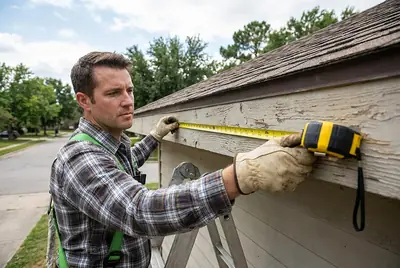
The measure that rules the job
Every fascia gets walked and taped before anything is ordered. The numbers written that day are the numbers the machine obeys.
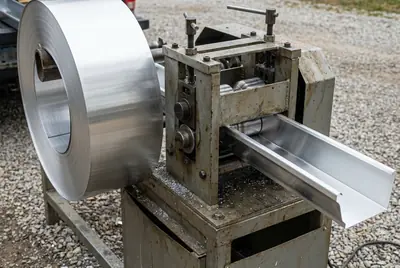
Forming at the curb
Flat coil goes into the roll former on the truck and a finished gutter profile comes out, cut off at the length of your run and not an inch more.
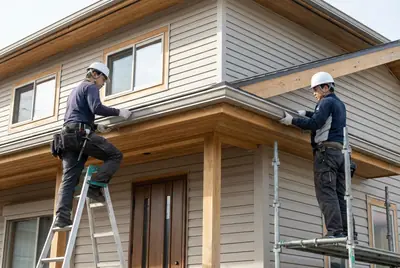
Hanging to a true pitch
Hidden hangers screwed into sound fascia, spaced for snow country where it applies, with a fall toward the outlet you can check with a hose.
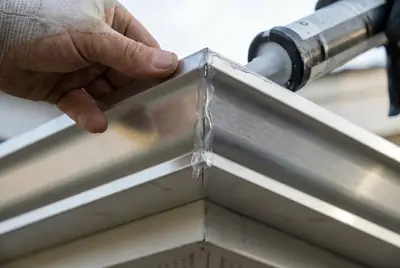
Corners mitered by hand
The only seams a seamless system has live at the corners, so ours are cut, lapped, riveted and sealed like they matter. Because they do.
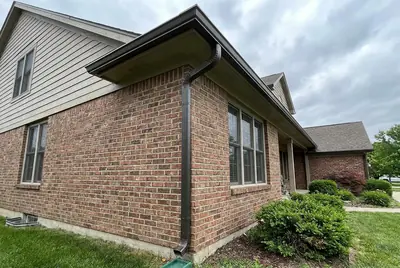
Downspouts that finish the story
Sized to the gutter that feeds them, dropped where the water should land, with extensions that carry it clear of the foundation.
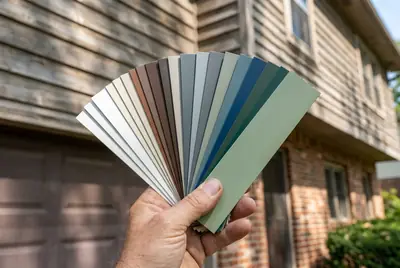
Color read against your trim
Factory painted coil comes in dozens of stock shades. We hold the chart against your fascia in daylight, not in a catalog.
The machine comes to you
Call the crew
One call to (855) 629-1479: ZIP, the kind of run and a word on the roofline. Under a minute, and nothing else is asked of you yet.
The measurer listens
On that same call the measurer hears the roofline out and books a time that suits the house.
Tape on fascia
Runs, drops, corners and colors are measured and settled on site. You get one written figure that holds.
The machine arrives
Forming day. The truck parks, the coil rolls, and each gutter comes off at the exact length it was measured for.
Hung and rinsed
Runs go up on hidden hangers, corners are sealed, downspouts dropped, and water is run through before we pull away.
What a foot of gutter costs
Stories, ladder access and fascia condition move a footage price up or down, which is why we measure before we promise. The figure you sign is the figure you pay.
Color comes off the coil, not out of a paint can
Seamless gutter stock arrives as factory painted aluminum coil, baked finish on both faces, in dozens of standing shades from bright white through bronzes and into true black. Because the color is cured onto the metal before it ever reaches the forming machine, it does not brush off, and it weathers evenly along the whole run.
Matching is done at your house. The measurer brings the coil chart to the fascia and reads it in your daylight, against your trim, your siding and your roof edge. Most homes want the gutter to disappear into the trim line; some want the downspouts to vanish against the siding instead, and the two choices are allowed to differ. If your trim sits between two stock shades, we will say so plainly and show you both instead of promising a custom tint we cannot roll.
What homeowners ask before signing
What does seamless actually mean here?
Each straight run is one continuous piece of metal, formed at your house to the length of that fascia. The only joints in the whole system sit at corners and outlets, where they are riveted and sealed by hand.
How long does the machine spend at my house?
For most homes the forming and the hanging fit inside a single visit. Long wraparound rooflines or three stories of ladder work can stretch it, and the quote says so before anyone commits.
Can you really match my trim color?
From dozens of factory painted coil shades, almost always closely enough that visitors never think about it. When your trim falls between two stock shades, you see both charts at the fascia and pick with your own eyes.
What happens to the gutters already on the house?
They come down the same day, fasteners and all, and leave in our truck for recycling. The tear off is its own line on the written quote, never a surprise.
Are corners a weak point?
They are the only seams the system has, which is exactly why they get the slow treatment: hand cut miters, riveted laps and sealant rated for wet metal. A corner done that way outlives the sealant tube it came from many times over.
Is a small house worth a seamless run?
Yes, the machine rolls a 20 ft run as happily as a 60 ft one. A small job minimum applies because the truck travels whole, and it is printed on the quote so you can judge it in writing.
Rooflines around Ohio
The terrain sets the pitch and the trees set the debris. The lists further down name every community the truck reaches from here.
County lines of Ohio
- Seamless Rain Gutters in Adams County, OH
- Seamless Rain Gutters in Allen County, OH
- Seamless Rain Gutters in Ashland County, OH
- Seamless Rain Gutters in Ashtabula County, OH
- Seamless Rain Gutters in Athens County, OH
- Seamless Rain Gutters in Auglaize County, OH
- Seamless Rain Gutters in Belmont County, OH
- Seamless Rain Gutters in Brown County, OH
- Seamless Rain Gutters in Butler County, OH
- Seamless Rain Gutters in Carroll County, OH
- Seamless Rain Gutters in Champaign County, OH
- Seamless Rain Gutters in Clark County, OH
- Seamless Rain Gutters in Clermont County, OH
- Seamless Rain Gutters in Clinton County, OH
- Seamless Rain Gutters in Columbiana County, OH
- Seamless Rain Gutters in Coshocton County, OH
- Seamless Rain Gutters in Crawford County, OH
- Seamless Rain Gutters in Cuyahoga County, OH
- Seamless Rain Gutters in Darke County, OH
- Seamless Rain Gutters in Defiance County, OH
- Seamless Rain Gutters in Delaware County, OH
- Seamless Rain Gutters in Erie County, OH
- Seamless Rain Gutters in Fairfield County, OH
- Seamless Rain Gutters in Fayette County, OH
- Seamless Rain Gutters in Franklin County, OH
- Seamless Rain Gutters in Fulton County, OH
- Seamless Rain Gutters in Gallia County, OH
- Seamless Rain Gutters in Geauga County, OH
- Seamless Rain Gutters in Greene County, OH
- Seamless Rain Gutters in Guernsey County, OH
The busiest eaves in Ohio
- Seamless Rain Gutters in Columbus, OH (home to 867,628)
- Seamless Rain Gutters in Poznan, OH (home to 396,815)
- Seamless Rain Gutters in Cleveland, OH (home to 387,398)
- Seamless Rain Gutters in Cincinnati, OH (home to 300,357)
- Seamless Rain Gutters in Toledo, OH (home to 278,193)
- Seamless Rain Gutters in Akron, OH (home to 198,314)
- Seamless Rain Gutters in Dayton, OH (home to 140,782)
- Seamless Rain Gutters in Parma, OH (home to 79,559)
- Seamless Rain Gutters in Canton, OH (home to 71,313)
- Seamless Rain Gutters in Youngstown, OH (home to 64,734)
- Seamless Rain Gutters in Lorain, OH (home to 63,773)
- Seamless Rain Gutters in Hamilton, OH (home to 62,477)
- Seamless Rain Gutters in Springfield, OH (home to 59,305)
- Seamless Rain Gutters in Kettering, OH (home to 55,405)
- Seamless Rain Gutters in Elyria, OH (home to 53,910)
- Seamless Rain Gutters in Lakewood, OH (home to 52,131)
- Seamless Rain Gutters in Cuyahoga Falls, OH (home to 49,317)
- Seamless Rain Gutters in Newark, OH (home to 49,070)
- Seamless Rain Gutters in Middletown, OH (home to 48,694)
- Seamless Rain Gutters in Euclid, OH (home to 47,456)
- Seamless Rain Gutters in Mentor, OH (home to 47,062)
- Seamless Rain Gutters in Mansfield, OH (home to 46,638)
- Seamless Rain Gutters in Beavercreek, OH (home to 46,600)
- Seamless Rain Gutters in Bluestone, OH (home to 46,121)
- Seamless Rain Gutters in Euclid Heights, OH (home to 46,121)
- Seamless Rain Gutters in Fairmount, OH (home to 46,121)
- Seamless Rain Gutters in Dublin, OH (home to 45,559)
- Seamless Rain Gutters in Cleveland Heights, OH (home to 44,865)
- Seamless Rain Gutters in Strongsville, OH (home to 44,752)
- Seamless Rain Gutters in Fairfield, OH (home to 42,636)
Next door in the Midwest
- Seamless Rain Gutters in Illinois
- Seamless Rain Gutters in Indiana
- Seamless Rain Gutters in Iowa
- Seamless Rain Gutters in Kansas
- Seamless Rain Gutters in Michigan
- Seamless Rain Gutters in Minnesota
- Seamless Rain Gutters in Missouri
- Seamless Rain Gutters in Nebraska
- Seamless Rain Gutters in North Dakota
- Seamless Rain Gutters in South Dakota
- Seamless Rain Gutters in Wisconsin
One ribbon of metal per run, and the drips have nowhere left to start.
Call (855) 629-1479