
Seamless Rain Gutters in Iowa (IA)
Anywhere in Iowa, the forming machine comes to the house. One continuous gutter per run, downspouts sized to match, one written figure for all of it.
The call costs nothing and commits you to nothing. Any trip fee for the measure is named when the date is set, and the written figure follows the measure.
- Counties covered
- 99
- Region
- Midwest
- Largest city
- Des Moines
Keeping your home dry in Iowa
Replacing your old drainage system with a single continuous metal channel prevents leaks at every corner. These custom fabricated troughs fit your roofline perfectly and stop water from dripping onto your siding or basement walls. Getting a free quote helps you secure a durable solution for your property in the Hawkeye State.
Why seamless is better for your home
Traditional systems rely on many short segments connected by leaky joints that rust and split over time. Choosing a design without gaps means water flows freely toward the downspouts instead of spilling over your flower beds. This simple upgrade keeps your foundation bone dry and protects your landscaping from erosion during heavy summer storms.
Because these units come in one long piece, you get an added sense of structural integrity for your roof edges. Most professionals create these right on site to ensure a precise fit against your fascia boards. That exact measurement prevents sagging and makes your house look much sharper from the curb.
Materials and durability in the Midwest
Aluminum remains a popular choice because it resists corrosion while staying lightweight enough for most residential structures. Copper provides a beautiful look that ages gracefully, although it costs a bit more than standard painted metal options. You should look for a heavy gauge thickness if you worry about falling tree limbs or heavy ice buildup during winter.
| Material | Benefit |
| Aluminum | Lightweight and rust proof |
| Copper | Long lasting and aesthetic |
| Steel | High impact resistance |
Selecting a corrosion resistant metal means you spend less time cleaning out debris or fixing cracks in the future. This longevity is a huge win for any budget because it saves you from expensive water damage repairs later. A good local pro will always explain the pros and cons of each alloy based on your specific roof pitch.
Protecting the foundation and siding
Water spilling near your home creates massive headaches like cracked concrete and muddy basements. Properly installed custom troughs direct every drop far away from the dirt surrounding your walls. This diversion keeps your house stable and prevents the soil from shifting under your feet.
You should always verify that your installer uses hidden hangers rather than old fashioned spikes that pop out. These sleek fasteners stay tucked inside the system for a clean visual appeal while holding the weight of heavy rain. That hidden strength is exactly what you need to keep things sturdy for many years.
Hiring the right local help
Finding a qualified professional around here requires checking for proper insurance and a valid contractor license. Ask to see proof of these documents to ensure you stay protected while someone works on your roofline. A trustworthy installer always carries the right liability coverage to handle any surprises during the job.
Requesting a written estimate allows you to compare costs without feeling forced into a quick decision. You deserve a transparent pricing structure that details exactly what materials go into your project. Getting multiple bids helps you find the most reliable hands for the job.
Preparing for the installation
Removing your old failing system is the first step toward a dry and happy household. Your pro will measure the perimeter of your roof to ensure the new continuous drainage channels fit perfectly. This preparation phase is vital because it reveals potential issues with your fascia boards that might need repair.
Once the new pieces arrive, the team hangs them at the correct slope to encourage fast runoff. Getting the angle right is a technical skill that prevents standing water inside the troughs. Proper drainage is the secret to a long life for your roof structure and siding.
Final steps for your project
Ensuring your downspouts discharge water at least five feet from the house prevents pooling. Adding extensions or splash blocks is an easy way to finish the job and move water into the yard. These small touches provide maximum protection for your property throughout the rainy seasons.
Take a moment to describe your specific project needs to connect with someone nearby who can help. Requesting a free quote is your next logical move to get these weather proofing solutions installed soon. Reach out today to start the conversation and keep your home safe from the elements.
Why one piece beats twenty-two
A sectional gutter arrives from a shelf in short lengths and gets stitched together on your fascia. A seamless gutter leaves our machine as a single ribbon of aluminum, already the length of the run it will serve. Everything below follows from that difference.
Profiles and sizes we roll
The machine changes its forming head, not its habits. Whichever profile your house calls for, the run still comes off the coil in one piece.
Not sure which size your roof sheds into? That is a measuring question, not a guessing question, and one call books the measure.
The craft, run by run
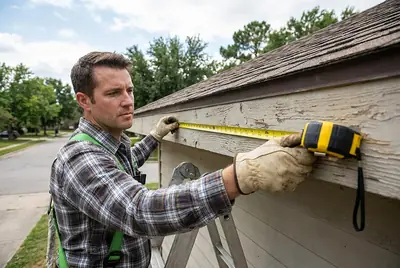
The measure that rules the job
Every fascia gets walked and taped before anything is ordered. The numbers written that day are the numbers the machine obeys.
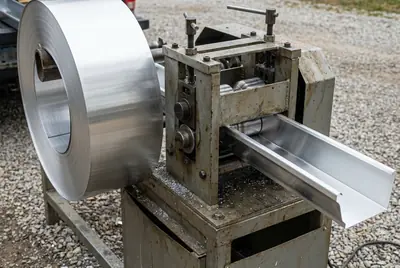
Forming at the curb
Flat coil goes into the roll former on the truck and a finished gutter profile comes out, cut off at the length of your run and not an inch more.
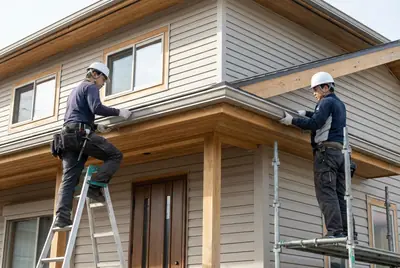
Hanging to a true pitch
Hidden hangers screwed into sound fascia, spaced for snow country where it applies, with a fall toward the outlet you can check with a hose.
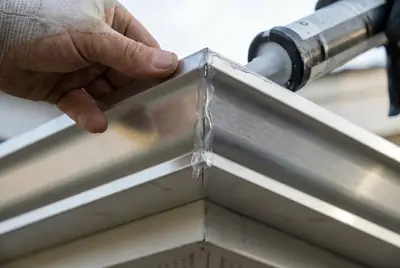
Corners mitered by hand
The only seams a seamless system has live at the corners, so ours are cut, lapped, riveted and sealed like they matter. Because they do.
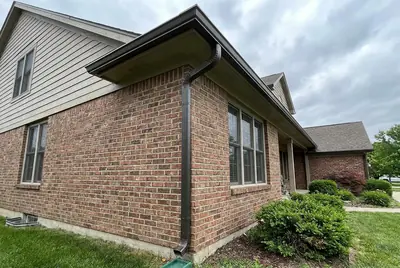
Downspouts that finish the story
Sized to the gutter that feeds them, dropped where the water should land, with extensions that carry it clear of the foundation.
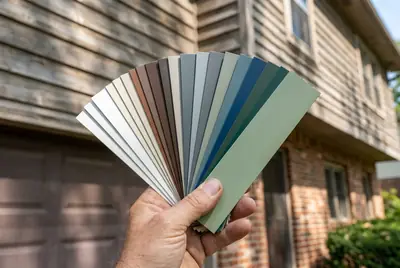
Color read against your trim
Factory painted coil comes in dozens of stock shades. We hold the chart against your fascia in daylight, not in a catalog.
The machine comes to you
Call the crew
One call to (855) 629-1479: ZIP, the kind of run and a word on the roofline. Under a minute, and nothing else is asked of you yet.
The measurer listens
On that same call the measurer hears the roofline out and books a time that suits the house.
Tape on fascia
Runs, drops, corners and colors are measured and settled on site. You get one written figure that holds.
The machine arrives
Forming day. The truck parks, the coil rolls, and each gutter comes off at the exact length it was measured for.
Hung and rinsed
Runs go up on hidden hangers, corners are sealed, downspouts dropped, and water is run through before we pull away.
What a foot of gutter costs
Stories, ladder access and fascia condition move a footage price up or down, which is why we measure before we promise. The figure you sign is the figure you pay.
Color comes off the coil, not out of a paint can
Seamless gutter stock arrives as factory painted aluminum coil, baked finish on both faces, in dozens of standing shades from bright white through bronzes and into true black. Because the color is cured onto the metal before it ever reaches the forming machine, it does not brush off, and it weathers evenly along the whole run.
Matching is done at your house. The measurer brings the coil chart to the fascia and reads it in your daylight, against your trim, your siding and your roof edge. Most homes want the gutter to disappear into the trim line; some want the downspouts to vanish against the siding instead, and the two choices are allowed to differ. If your trim sits between two stock shades, we will say so plainly and show you both instead of promising a custom tint we cannot roll.
What homeowners ask before signing
What does seamless actually mean here?
Each straight run is one continuous piece of metal, formed at your house to the length of that fascia. The only joints in the whole system sit at corners and outlets, where they are riveted and sealed by hand.
How long does the machine spend at my house?
For most homes the forming and the hanging fit inside a single visit. Long wraparound rooflines or three stories of ladder work can stretch it, and the quote says so before anyone commits.
Can you really match my trim color?
From dozens of factory painted coil shades, almost always closely enough that visitors never think about it. When your trim falls between two stock shades, you see both charts at the fascia and pick with your own eyes.
What happens to the gutters already on the house?
They come down the same day, fasteners and all, and leave in our truck for recycling. The tear off is its own line on the written quote, never a surprise.
Are corners a weak point?
They are the only seams the system has, which is exactly why they get the slow treatment: hand cut miters, riveted laps and sealant rated for wet metal. A corner done that way outlives the sealant tube it came from many times over.
Is a small house worth a seamless run?
Yes, the machine rolls a 20 ft run as happily as a 60 ft one. A small job minimum applies because the truck travels whole, and it is printed on the quote so you can judge it in writing.
Rooflines around Iowa
The terrain sets the pitch and the trees set the debris. The lists further down name every community the truck reaches from here.
County lines of Iowa
- Seamless Rain Gutters in Adair County, IA
- Seamless Rain Gutters in Adams County, IA
- Seamless Rain Gutters in Allamakee County, IA
- Seamless Rain Gutters in Appanoose County, IA
- Seamless Rain Gutters in Audubon County, IA
- Seamless Rain Gutters in Benton County, IA
- Seamless Rain Gutters in Black Hawk County, IA
- Seamless Rain Gutters in Boone County, IA
- Seamless Rain Gutters in Bremer County, IA
- Seamless Rain Gutters in Buchanan County, IA
- Seamless Rain Gutters in Buena Vista County, IA
- Seamless Rain Gutters in Butler County, IA
- Seamless Rain Gutters in Calhoun County, IA
- Seamless Rain Gutters in Carroll County, IA
- Seamless Rain Gutters in Cass County, IA
- Seamless Rain Gutters in Cedar County, IA
- Seamless Rain Gutters in Cerro Gordo County, IA
- Seamless Rain Gutters in Cherokee County, IA
- Seamless Rain Gutters in Chickasaw County, IA
- Seamless Rain Gutters in Clarke County, IA
- Seamless Rain Gutters in Clay County, IA
- Seamless Rain Gutters in Clayton County, IA
- Seamless Rain Gutters in Clinton County, IA
- Seamless Rain Gutters in Crawford County, IA
- Seamless Rain Gutters in Dallas County, IA
- Seamless Rain Gutters in Davis County, IA
- Seamless Rain Gutters in Decatur County, IA
- Seamless Rain Gutters in Delaware County, IA
- Seamless Rain Gutters in Des Moines County, IA
- Seamless Rain Gutters in Dickinson County, IA
The busiest eaves in Iowa
- Seamless Rain Gutters in Des Moines, IA (home to 215,932)
- Seamless Rain Gutters in Cedar Rapids, IA (home to 131,360)
- Seamless Rain Gutters in Davenport, IA (home to 102,318)
- Seamless Rain Gutters in Sioux City, IA (home to 82,486)
- Seamless Rain Gutters in Iowa City, IA (home to 74,566)
- Seamless Rain Gutters in Waterloo, IA (home to 68,134)
- Seamless Rain Gutters in Ames, IA (home to 65,937)
- Seamless Rain Gutters in West Des Moines, IA (home to 64,400)
- Seamless Rain Gutters in Council Bluffs, IA (home to 62,478)
- Seamless Rain Gutters in Ankeny, IA (home to 59,152)
- Seamless Rain Gutters in Dubuque, IA (home to 58,340)
- Seamless Rain Gutters in Ashawa, IA (home to 56,609)
- Seamless Rain Gutters in Commerce, IA (home to 56,609)
- Seamless Rain Gutters in Valley Junction, IA (home to 56,609)
- Seamless Rain Gutters in Urbandale, IA (home to 42,881)
- Seamless Rain Gutters in Cedar Falls, IA (home to 41,202)
- Seamless Rain Gutters in Marion, IA (home to 38,699)
- Seamless Rain Gutters in Bettendorf, IA (home to 35,793)
- Seamless Rain Gutters in Mason City, IA (home to 27,309)
- Seamless Rain Gutters in Marshalltown, IA (home to 27,275)
- Seamless Rain Gutters in Lyons, IA (home to 26,885)
- Seamless Rain Gutters in Clinton, IA (home to 25,637)
- Seamless Rain Gutters in Burlington, IA (home to 25,127)
- Seamless Rain Gutters in Ottumwa, IA (home to 24,676)
- Seamless Rain Gutters in Fort Dodge, IA (home to 24,417)
- Seamless Rain Gutters in Muscatine, IA (home to 23,864)
- Seamless Rain Gutters in Johnston, IA (home to 20,767)
- Seamless Rain Gutters in Coralville, IA (home to 20,645)
- Seamless Rain Gutters in Waukee, IA (home to 19,344)
- Seamless Rain Gutters in North Liberty, IA (home to 18,357)
Next door in the Midwest
- Seamless Rain Gutters in Illinois
- Seamless Rain Gutters in Indiana
- Seamless Rain Gutters in Kansas
- Seamless Rain Gutters in Michigan
- Seamless Rain Gutters in Minnesota
- Seamless Rain Gutters in Missouri
- Seamless Rain Gutters in Nebraska
- Seamless Rain Gutters in North Dakota
- Seamless Rain Gutters in Ohio
- Seamless Rain Gutters in South Dakota
- Seamless Rain Gutters in Wisconsin
One ribbon of metal per run, and the drips have nowhere left to start.
Call (855) 629-1479