
Seamless Rain Gutters in Carter County, Missouri (MO)
From one end of Carter County to the other, our crews form gutters on site so each run goes up whole, with the coil color settled against your trim first.
The call costs nothing and commits you to nothing. Any trip fee for the measure is named when the date is set, and the written figure follows the measure.
Finding top-tier metal channel systems for your home in Carter County
You protect your foundation and siding by installing high-quality, continuous metal water diversion systems that prevent messy overflows. These custom-fitted troughs effectively route rainwater away from your structure, which shields your investment from costly erosion and moisture damage. You can easily request a free quote to connect with local pros who specialize in these essential home additions throughout this Missouri region.
Why continuous drainage solutions matter
Traditional drainage setups often rely on multiple segments joined by fasteners that eventually loosen and leak. Continuous metal runners eliminate those failure points because they feature a single, unbroken length from corner to corner. That seamless design means you stop worrying about drips at every seam, and the lack of gaps keeps debris from catching and causing blockages.
Choosing materials like aluminum or copper helps you manage heavy rainfall without the constant maintenance required by older systems. These durable channels stand up to intense storms common in these parts while maintaining their shape. Because they are custom-cut on-site to fit your roofline perfectly, you get a clean look that boosts your home aesthetic without sacrificing functional strength.
How the installation process works
Skilled installers bring a specialized machine to your property to shape the metal exactly to your building specifications. This precision creates a perfect flow for heavy downpours, and the benefit is that your landscape avoids the trenches often carved by spilling water. You should always look for a pro who understands local weather patterns to ensure your setup handles the specific volume of rain expected here.
Checking for quality and reliability
Asking for a licensed and insured technician ensures you stay protected while the work happens on your roofline. You want a pro who uses high-quality hangers and fasteners to keep the channels steady during high winds. This hardware keeps everything aligned correctly, which means your system moves water efficiently even during the most aggressive Missouri cloudbursts.
Beyond the hardware, you should check for a written warranty on the installation and the materials used. A good local contractor will happily explain their process for mounting these channels to your fascia boards. Getting everything in writing clarifies what to expect, and that clarity provides a deep sense of peace of mind while the job gets finished.
Managing your drainage needs effectively
Maintaining these systems is relatively simple since the lack of joints means fewer spots for leaves and twigs to gather. You still need to clear out occasional buildup, but the smooth interior of these channels makes the task much quicker. Investing in guards or screens is another smart move to keep your runoff flowing freely, and the upside is that you save time on manual cleanings each season.
If you find that your current setup is sagging or overflowing, you might need to look into a total replacement. Modern metal channels offer superior corrosion resistance and can be color-matched to your exterior for a sleek finish. You can get a free quote today by describing your project to local providers who handle these precise jobs across the county.
What to watch for during your search
Look for a professional who prioritizes proper pitch to ensure water flows toward the downspouts rather than pooling in the middle. A slight slope is necessary for gravity to do its job, and that correct angle keeps your home dry throughout the year. You want someone who calculates these requirements accurately so your system works exactly as intended from day one.
Consider the thickness of the metal to ensure your troughs do not dent or warp under the weight of wet leaves or ice. Stronger materials like heavy-gauge aluminum provide the durability you need for long-term satisfaction. That toughness saves you money by reducing the frequency of repairs or replacements over the coming years.
Making the right choice for your residence
Evaluating your options involves thinking about the overall drainage capacity of your roof and the frequency of heavy rain in this area. You want a system that handles high volumes without overflowing, which keeps your siding and basement safe from water intrusion. Getting a professional assessment helps you decide on the right size and style for your particular building structure.
Taking the next step is easy when you reach out to local pros for a custom plan tailored to your home needs. You can ask for a free quote to compare different options and find the best water management solution for your property. Just share your project details now to get the process started and ensure your home stays dry during the wettest months.
Why one piece beats twenty-two
A sectional gutter arrives from a shelf in short lengths and gets stitched together on your fascia. A seamless gutter leaves our machine as a single ribbon of aluminum, already the length of the run it will serve. Everything below follows from that difference.
Profiles and sizes we roll
The machine changes its forming head, not its habits. Whichever profile your house calls for, the run still comes off the coil in one piece.
Not sure which size your roof sheds into? That is a measuring question, not a guessing question, and one call books the measure.
The craft, run by run
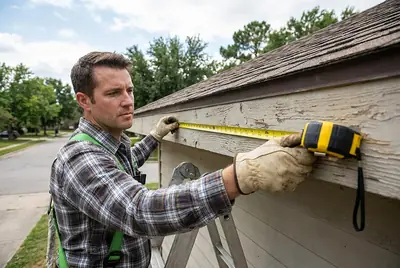
The measure that rules the job
Every fascia gets walked and taped before anything is ordered. The numbers written that day are the numbers the machine obeys.
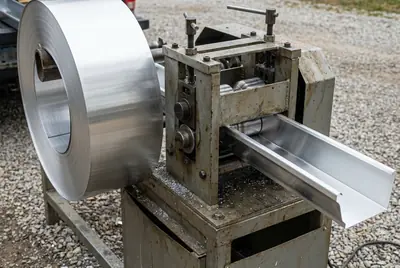
Forming at the curb
Flat coil goes into the roll former on the truck and a finished gutter profile comes out, cut off at the length of your run and not an inch more.
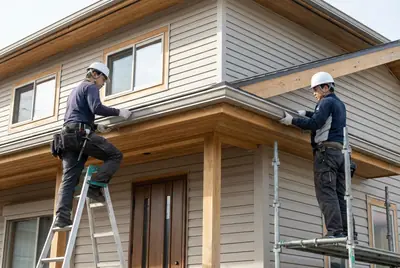
Hanging to a true pitch
Hidden hangers screwed into sound fascia, spaced for snow country where it applies, with a fall toward the outlet you can check with a hose.
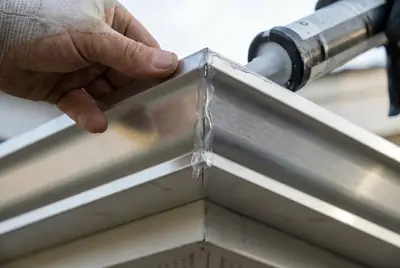
Corners mitered by hand
The only seams a seamless system has live at the corners, so ours are cut, lapped, riveted and sealed like they matter. Because they do.
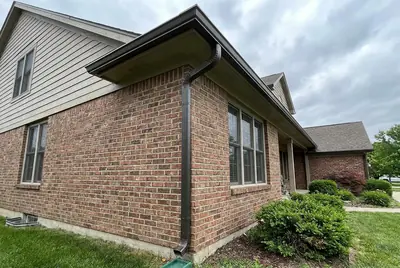
Downspouts that finish the story
Sized to the gutter that feeds them, dropped where the water should land, with extensions that carry it clear of the foundation.
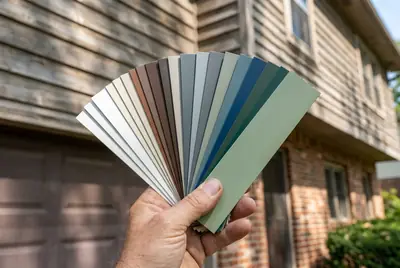
Color read against your trim
Factory painted coil comes in dozens of stock shades. We hold the chart against your fascia in daylight, not in a catalog.
The machine comes to you
Call the crew
One call to (855) 629-1479: ZIP, the kind of run and a word on the roofline. Under a minute, and nothing else is asked of you yet.
The measurer listens
On that same call the measurer hears the roofline out and books a time that suits the house.
Tape on fascia
Runs, drops, corners and colors are measured and settled on site. You get one written figure that holds.
The machine arrives
Forming day. The truck parks, the coil rolls, and each gutter comes off at the exact length it was measured for.
Hung and rinsed
Runs go up on hidden hangers, corners are sealed, downspouts dropped, and water is run through before we pull away.
What a foot of gutter costs
Stories, ladder access and fascia condition move a footage price up or down, which is why we measure before we promise. The figure you sign is the figure you pay.
Color comes off the coil, not out of a paint can
Seamless gutter stock arrives as factory painted aluminum coil, baked finish on both faces, in dozens of standing shades from bright white through bronzes and into true black. Because the color is cured onto the metal before it ever reaches the forming machine, it does not brush off, and it weathers evenly along the whole run.
Matching is done at your house. The measurer brings the coil chart to the fascia and reads it in your daylight, against your trim, your siding and your roof edge. Most homes want the gutter to disappear into the trim line; some want the downspouts to vanish against the siding instead, and the two choices are allowed to differ. If your trim sits between two stock shades, we will say so plainly and show you both instead of promising a custom tint we cannot roll.
What homeowners ask before signing
What does seamless actually mean here?
Each straight run is one continuous piece of metal, formed at your house to the length of that fascia. The only joints in the whole system sit at corners and outlets, where they are riveted and sealed by hand.
How long does the machine spend at my house?
For most homes the forming and the hanging fit inside a single visit. Long wraparound rooflines or three stories of ladder work can stretch it, and the quote says so before anyone commits.
Can you really match my trim color?
From dozens of factory painted coil shades, almost always closely enough that visitors never think about it. When your trim falls between two stock shades, you see both charts at the fascia and pick with your own eyes.
What happens to the gutters already on the house?
They come down the same day, fasteners and all, and leave in our truck for recycling. The tear off is its own line on the written quote, never a surprise.
Are corners a weak point?
They are the only seams the system has, which is exactly why they get the slow treatment: hand cut miters, riveted laps and sealant rated for wet metal. A corner done that way outlives the sealant tube it came from many times over.
Is a small house worth a seamless run?
Yes, the machine rolls a 20 ft run as happily as a 60 ft one. A small job minimum applies because the truck travels whole, and it is printed on the quote so you can judge it in writing.
Rooflines around Carter County
The terrain sets the pitch and the trees set the debris. The lists further down name every community the truck reaches from here.
Towns of Carter County on our route sheet
- Seamless Rain Gutters in Van Buren, MO (home to 1,080)
- Seamless Rain Gutters in South Van Buren, MO (home to 824)
- Seamless Rain Gutters in Ellsinore, MO (home to 498)
- Seamless Rain Gutters in Grandin, MO (home to 269)
- Seamless Rain Gutters in Hunter, MO (home to 128)
- Seamless Rain Gutters in Fremont, MO (home to 28)
The rest of Missouri, county after county
- Seamless Rain Gutters in Adair County, MO
- Seamless Rain Gutters in Andrew County, MO
- Seamless Rain Gutters in Atchison County, MO
- Seamless Rain Gutters in Audrain County, MO
- Seamless Rain Gutters in Barry County, MO
- Seamless Rain Gutters in Barton County, MO
- Seamless Rain Gutters in Bates County, MO
- Seamless Rain Gutters in Benton County, MO
- Seamless Rain Gutters in Bollinger County, MO
- Seamless Rain Gutters in Boone County, MO
- Seamless Rain Gutters in Buchanan County, MO
- Seamless Rain Gutters in Butler County, MO
- Seamless Rain Gutters in Caldwell County, MO
- Seamless Rain Gutters in Callaway County, MO
- Seamless Rain Gutters in Camden County, MO
- Seamless Rain Gutters in Cape Girardeau County, MO
- Seamless Rain Gutters in Carroll County, MO
- Seamless Rain Gutters in Cass County, MO
- Seamless Rain Gutters in Cedar County, MO
- Seamless Rain Gutters in Chariton County, MO
- Seamless Rain Gutters in Christian County, MO
- Seamless Rain Gutters in City of Saint Louis, MO
- Seamless Rain Gutters in Clark County, MO
- Seamless Rain Gutters in Clay County, MO
- Seamless Rain Gutters in Clinton County, MO
- Seamless Rain Gutters in Cole County, MO
- Seamless Rain Gutters in Cooper County, MO
- Seamless Rain Gutters in Crawford County, MO
- Seamless Rain Gutters in Dade County, MO
- Seamless Rain Gutters in Dallas County, MO
One ribbon of metal per run, and the drips have nowhere left to start.
Call (855) 629-1479